Supporting Ninma Tamang Ghale After Devastating Floods
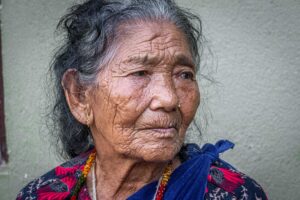
At 82 years old, Ninma Tamang Ghale is the widow of Rifleman Sete Ghale of the 4th Gurkha Rifles. Following his passing in 2002, we have been proud to support Ninma, who lives alongside her daughter-in-law Kalpana and her grandchildren.
Over the years, we’ve taken steps to make her daily life more comfortable, building her a brand-new, Earthquake-Resilient home in 2016 and installing a clean water supply right at her doorstep in 2018.
A home swept away in seconds
For Nigma, home is not simply somewhere to live. It is the place where she has spent many years of her life, surrounded by her family and the few possessions that connected her to the past.
Then, in a matter of seconds, it was gone.
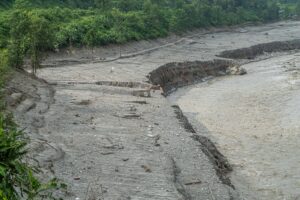
“We had no time to even put on our slippers.” Kalpana remembers the morning of 26 August vividly.
It was around 9.30am and the family was preparing to eat. The food was already on their plates when Kalpana’s phone rang. Her nephew had called to warn her that a flood was coming down from Rasuwa. At first, the warning was difficult to believe, but when her daughter saw the river, she came running back, shouting.
Ninma was still reluctant to leave her home. “She said, ‘If I die, I will die in this house.’ But I insisted she come with us.” Kalpana lifted her mother-in-law onto her back and ran towards the hill with Nigma, her daughter and her son.
They barely escaped. “While going uphill, the water had already reached up to our knees. The water was all muddy. We ran barefoot. We had no time to even put on a slipper.” The flood did not arrive in the way they expected. “The river didn’t come up its usual route. It came from above. A huge wave. It came all of a sudden from a hill.”
From the safety of the hillside, the family watched as the flood swept through the settlement. “We could see the water flip our house and destroy it in one wave.”
Then came the sound. “Before the flood came, it made a loud noise like a bomb explosion. The river made a very loud noise. A huge mist of water like smoke was seen in the sky.”
There was little time to understand what was happening. “I don’t remember much as, at that time, our main objective was to save our lives.”
For several minutes, the river raged through the settlement. “All the people also ran towards the hill. For five minutes the river was very angry, destroying everything on its path. Later it calmed down a little.”
What the family had spent years building disappeared almost instantly.
Kalpana knows how close they came to losing their lives.
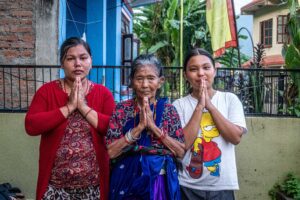
“If I had stayed there for even a few seconds collecting my valuables, then the river would have taken me. But luckily all of us survived.” Looking back, Kalpana knows that a few moments could have changed everything. “If our daughter had not gone out, seen the river and warned us, then we would have surely been swept away.”
There was no day or night
Surviving the initial flood did not mean the danger was over. For five or six days, the family stayed in the jungle, frightened that another surge of water could come. “People would shout, ‘The water is coming again.’ Then all of us ran. I again carried my mother-in-law and ran towards the hills and jungle. At one time we even slipped and fell.”
Another warning came at around four in the morning. “Then again we did the same. There was no day or night for us.” The family had lost their home, their belongings, and their sense of security. They were fortunate that relatives had an empty house where they could stay temporarily, but they knew they could not remain there for long.
For several days after the flood, the family struggled even to eat. “For three, four days we didn’t eat. We only kept thinking about our house, the incident.”
GWT reaches the family
In the days following the flood, even something as simple as keeping a telephone charged became difficult. That phone had become the family’s only link to the outside world. As soon as Kalpana was able to contact the Area Welfare Centre, she told the Welfare Officer what had happened. “He said they will come to help us.”
Area Welfare Officer Bishnu Garbuja Pun told us, “As soon as we received a call from the daughter-in-law, we had a meeting immediately. A team consisting of myself, the driver and medical staff got ready and deployed. We didn’t know what it would be like. We had tents, food supplies, medicines and other items with us. But at that time, we could not cross the river as the family was on the other side. We tried again later and gave them the items they needed, which provided some immediate relief.”
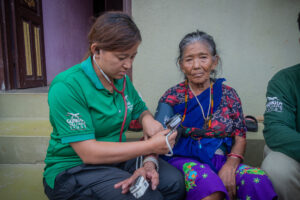
Our team continued to support the family. Necessary items were purchased for them, while some staff also brought clothes from their own homes to give to the family.
For Nigma, the loss of her home means losing the place where she had expected to spend the final years of her life. Ninma speaks and understands only the Tamang dialect, so her words were translated for us.
“I am just worried now about what to do. I had never imagined such a big flood would come and do so much destruction.” At 82, she knows she is becoming increasingly dependent on her family. “I am old now. But if the welfare builds me a small home where I can stay, I would be grateful. I would like to stay there till the end and take my last breath at my own house.”
GWT is continuing to look at how best to support them as they begin to rebuild their lives.