Tales from Gurkha veteran Tulajit Sunwar
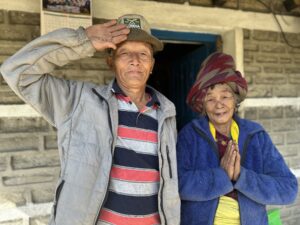
78-year-old Gurkha veteran Tulajit Sunwar lives with his wife, youngest son, and grandson in an Earthquake-Resilient home constructed by GWT.
Tulajit joined the British Army as a rifleman of the 7th Gurkha Rifles in 1965. He shared some stories of his time in service with our field team during a recent visit.
A brush with Malaria
“After being recruited in Dharan in 1965, I travelled to Calcutta from Jogmani by train, where we stayed for around a month before travelling on to Malaysia for training as the ships only travelled every 15 days. In Calcutta, we stayed in tents, and despite having mosquito nets, I got sick from malaria due to the abundance of mosquitoes.”
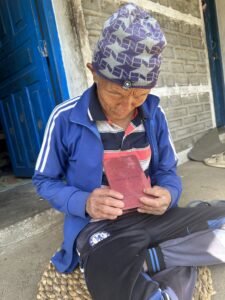
Military exercises in the Jungle of Kuntang
“Once I had recovered, I returned to my brigade and participated in a month-long exercise focusing on battle tactics. We replicated a battle scenario, crossing Singapore on a ship and reaching a place called Kuntang. It was a month-long exercise where we had to attack the officer’s battalion, simulating a real battle. During the exercise, while moving through the jungle, they fired a grenade-like device called demo thunder blast, a blank fire, which exploded right where I was. I couldn’t hear or see properly.
My friends to the left and right of me were running and attacking back but after a few steps, I couldn’t see anything and I was withdrawn to the platoon headquarters for a check-up. I was taken to a hospital in Singapore where I stayed for 15 days. Once I had recovered fully, I was deployed to Hong Kong due to the ongoing disputes between China and Britain at the border.
Gurkha soldiers had to fulfil their duty in a place called Sekong. Once, we went to a place called Satiko on China’s border, where I experienced a significant earthquake. We also had to search for enemies in the market. Chinese people used to wave their flags over hills, and we had to go and remove them. A British officer died while attempting to remove a flag, as they had set up an ambush where a bomb exploded and killed him. Thus, we had to guard and fulfil our duties responsibly. We were an infantry battalion and always had to stay on guard.
I served in the Army for 4 years and 241 days. After the war and its effects subsided, the British Army downsized, and I, along with many others, was made redundant during that process.”
Life back in Nepal: Turning to teaching
“Upon returning to Nepal, I had to work as a farmer. Later, with a friend, Dhan Bahadur Sunwar (a retired Sergeant, a PT instructor, and an education instructor), and with the help of a few other servicemen, we opened a school. In such a remote area, there was a shortage of teachers and schools. Dhan Bahadur and I taught various subjects like Nepali, English, and math at the primary school level. Initially, it was a school up to grade 5, but over time, it expanded to become a school up to class 12. I am genuinely happy and proud of the educational opportunities we provided to the villagers and their children.”
Bringing clean water to Tulajit’s Community
“In 1992, a water project was initiated in our village, resulting in the construction of 31 water taps. Each water tap served 2 or 3 households. This project improved access to drinking water in our village and later in nearby areas.
The GWT welfare office, located in Ghingamali near the Bhuji area, was central for the ex-servicemen around this region. However, due to the Maoist insurgency and other factors, the office was relocated to Jiri. It operated for only about three years before being shut down, continuing its services solely from Bagmati. Despite the changes, the welfare office ran successfully, celebrating 50 years. They commemorated the occasion by giving us hats. GWT has also contributed significantly by building a major school in our area.”
Medical aid providing relief to Tulajit
“My left knee is slightly weak, and I experience numbness. This may be related to high blood pressure. Climbing hills or carrying heavy loads has become difficult for me. Despite visiting a hospital in Kathmandu twice, where the doctors stated that everything was normal based on my reports, I still have pain in my left leg. All hospital expenses were covered by GWT. I take medication for high blood pressure, use ointment for knee pain, and take paracetamol for headaches.
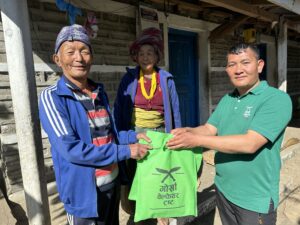
Without the help and medical services from the welfare, it would have been very challenging. I would have had to rely on local herbal medicine.
I express my gratitude to all the donors who, as fellow citizens, engage in humanitarian work. A citizen helping a citizen from a different country. Your support and assistance have brought relief to the lives of people like us, and for that, I am truly thankful. May you live long, and may the humanitarian works you are involved in always be remembered. Thank you.”