Meet the Team: Kedar Rai
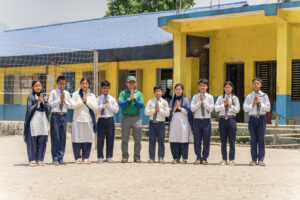
The Gurkha Welfare Trust operates from 20 Area Welfare Centres (AWCs) across Nepal and one in Darjeeling, India, based in traditional Gurkha recruitment areas. The majority of our 500+ staff in Nepal are veterans themselves. The AWCs oversee the distribution of financial and medical assistance to Gurkha veterans within their respective regions. Moreover, they manage community development projects, including the construction of school buildings and the installation of drinking water systems in remote Nepali communities.
28 years service to the Crown
Capt (Ret’d) Kedar Rai is the Senior Area Welfare Officer at AWC Dharan. Kedar served in the Queen’s Gurkha Signals for 28 years and was deployed to many parts of the world including Iraq and Afghanistan.
“I am originally from Diktel in eastern Nepal. I was born in Hong Kong as my father was a soldier in the Gurkha Transport Regiment. After his retirement, we moved back to our village in Diktel. I was two-and-a-half years old then. I grew up and completed my schooling in the village.
“My father had eight siblings and seven of them joined the British Army. I was recruited from my village through a ‘gallah’, now they are known as Senior Recruiting Assistants. I was eighteen-and-a-half years old when I joined the British Army. As far as I remember, a total of seven joined the British Army from the same school I studied in.
“I joined the British Army on 20th June 1988. In my twenty-eight years of service, I served with the Queen’s Gurkha Signals alongside the Royal Signals. I have deployed to many parts of the world. In 1992 and 1993 in Sarajevo, Kosovo and Bosnia Herzegovina, I did three tours there. In 2001, in Iraq OP TELEC I. After that, in Afghanistan in 2008.”
Kedar retired from the Army in 2016 and immediately joined the then Gurkha Welfare Scheme, now the Gurkha Welfare Trust. He is married and has a daughter who lives and works in the UK
“It has been over seven years since I joined and I have been enjoying my job here, working for the benefit of not only the beneficiaries, veterans and their dependents but most importantly, our communities as well. It is about job satisfaction in the end. I have got few more years and I have yet to decide whether I will stay in Nepal or go to UK when I leave this job.”
Rising to the Challenge
Nepal’s mountainous terrain, lack of good roads and the heavy downpours of the monsoon season make travelling incredibly difficult. Although most construction projects are paused during the monsoon, our staff still need to make home visits to the most vulnerable of our pensioners.
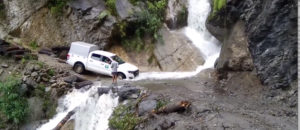
“In the past, it used to take us a minimum of four days to walk to Dharan from my village. Now, we have road access, but it’s still about an eight to nine hours’ drive. Our main challenges are the geography, the weather and our movement from A to B. Because it is challenging during the monsoon due to flash floods, landslides etc.”
“Another challenge is the expectation of our beneficiaries. They have high expectations from the Gurkha Welfare Trust. Sometimes, the beneficiaries think they can get whatever they ask for, but GWT has its own constraints and limitations due to funding.”
“In terms of importance, our beneficiaries come first. But our communities are also equally important, because those are the communities from where we get potential Gurkha recruits. Doing more for the community helps increase the Gurkha footprint. This will also reduce the difficulty of recruiting Gurkhas in the future.”
Meeting the Trust’s high standards
“I am involved in the projects from their start to finish. In the past year Area Welfare Centre Dharan has managed a total of nine projects which were all completed on time. They were all completed in five to six months’ time. We keep a very close eye on our projects to ensure that they meet the Trust’s standards.
“Area Welfare Centre Dharan has a big area of responsibility, covering eight districts. The communities come to us, or we go to them – we physically visit the school to understand their actual needs. Their requirements could be furniture, roof replacement, painting, playground, perimeter fence or classrooms. And if think that there is a genuine need, we complete the documents and submit to our GWT headquarters for further consideration from the board.
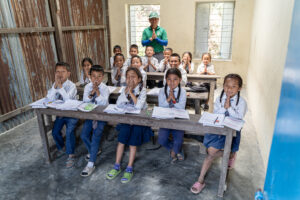
“Balkalyan School is the one I personally visited on receipt of their application. I witnessed that the school had challenges. They lack classrooms and furniture. They don’t have a library. Although they have some computers, they do not have a proper computer library. All ten teachers are cramped in one room. They also lack proper male toilets. Basically, they need a lot! How much we can help is the question.
“Donors are our gods. Not just for us, but also for our beneficiaries and our communities. Without the kind generosity of our donors back in the UK and elsewhere, without their support, the Gurkha Welfare Trust would not survive.”