Against All Odds: Bringing Specialist Healthcare to the Mountains of Humla
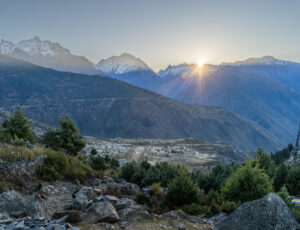
Reaching Simkot, one of the highest, most isolated, and least-developed regions in Nepal
The Gurkha Welfare Trust scheduled a Specialist Outreach Camp in Simkot, to bring ear care, surgery, hearing aids, and rehabilitation services to a region where specialist medical care is virtually non-existent.
What followed was an extraordinary race against time, nature, and the elements, both for the team delivering the equipment and for the hundreds of patients who travelled for days to receive care.
The Race Against the Road
The admin team set out from Pokhara on 13 September with a Land Cruiser and a hired bus carrying essential medical equipment, anticipating a standard four-day overland journey.
However, nature had other plans. On 16 September, a 4.0-magnitude earthquake struck nearby Dailekh, triggering massive mudslides that completely blocked the road near Sarkegad. The team had to cross the mudslide on foot and hitch a ride on the back of a tipper truck to reach shelter, while the drivers stayed behind in their vehicles.
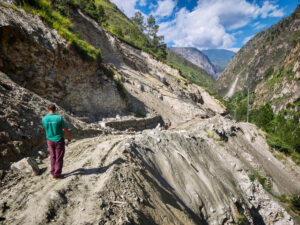
While the medical team flew into Simkot on 17 September to begin deep-cleaning and setting up the district hospital, the life-saving equipment remained trapped behind multiple landslides.

When narrow tracks at Chhare Bhir stopped the bus and a massive rockslide at Lali Bagadh blocked the road, the team dispatched two hired tractors from Simkot. Equipment was hand-transferred across the rockslide onto the tractors to navigate the hazardous terrain.
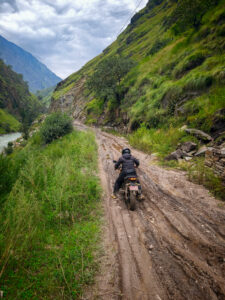
Motorcyclists rode ahead over mud-slicked mountain trails to assess the route ahead.
The team finally reached Simkot at midnight on 18 September, after six days on the road instead of four. Alongside the medical staff, they unloaded equipment until 2.00am, fumigating the operating theatre just hours before doors opened.
Against all odds, the GWT Specialist Outreach Camp opened its doors at 9.30am on 19 September, just 90 minutes behind schedule.
Extraordinary Journeys by Patients
It wasn’t only the GWT staff who struggled to make their way to the Medical Camp. Monsoon rains and active landslides had cut off off-road vehicle access across seven municipalities. To reach the camp, many patients had to walk for two to three days through very difficult conditions.
Patients crossed raging rivers using traditional tuins (cable trolley crossings), scaled wooden ladders, and navigated active landslide zones, sometimes securing themselves with ropes tied around their waists for safety.
Life-Changing Impact: Stories from the Camp
By the end of the three-day camp, the team achieved life-changing outcomes:– 554 total patient registrations
– 63 ear surgeries performed & 50 complex referrals
– 119 hearing aids fitted and distributed
– 92 assistive devices measured or distributed
Dharma Chandra Jaisi: Hearing Clearly After 20 Years
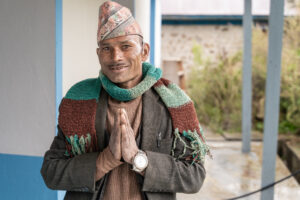
Dharma Chandra, 45, walked three days from Tanjakot to reach the camp. Living with holes in both eardrums since his early twenties, he faced heavy financial pressure farming and supporting his sons’ education. After receiving screening and treatment at the camp, Dharma Chandra could hear clearly again.
“I can hear properly now… I would like to thank the doctors. I hope the door to new opportunities always remains open to them.”
Dipesh Khatri: Restoring Hope and Dignity
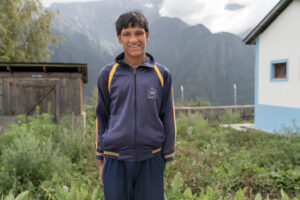
Sixteen-year-old orphan Dipesh lost the use of his left hand in a severe burn accident when he was just ten years old. At the camp, health professionals measured his arm for an artificial hand.
“I know it won’t be functional, but at least it will look like I have a hand again,” Dipesh shared. For a young student growing up in Simkot, the prosthesis offers something priceless: confidence for the future.
Narayan Phadera: Surgery After 15 Years of Waiting

Narayan, a local pharmacist in Simkot, first developed severe hearing problems 15 years ago while studying in Kathmandu. Though doctors recommended surgery, he simply could not afford the treatment in the city. At the GWT camp, Narayan underwent successful, free ear surgery to repair his eardrum.
“If we need to go to the cities for treatment, staying for two weeks would cost us more than NPR 150,000 to 300,000. All that is saved because you came here… Dhanyabad!”
Why Outreach Matters
Travelling to city hospitals in Kathmandu or Nepalgunj for specialist care costs rural families hundreds of thousands of rupees in travel, accommodation, and medical bills, an impossible expense for most.
The Specialist Outreach Camp in Humla proved that despite mudslides, earthquakes, and treacherous roads, bringing healthcare directly to remote mountain communities bridges a vital gap.
Every mile driven, tractor hired, and mountain trail walked was worth it to bring hope, health, and healing to the people of Humla.