A New Beginning in the Hills – Lila’s Journey to a Safe New Home
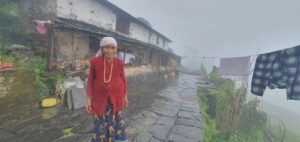
High up in the hills of western Nepal, around three hours northwest of Pokhara, lives Lila Kumari Gurung – a proud but humble 92-year-old woman with a life story that reaches back to the days of the Second World War.
Her quiet village lies along a dirt road, this is where she has lived for most of her life. And this is where a new chapter recently began.
The harsh life of a soldier
Lila Kumari is the widow of late Rifleman Gun Prasad Gurung, a Gurkha soldier who served in the 5/1 Gurkha Rifles during WWII. After joining the Army, Gun Prasad fought in some of the harshest terrain of the North-West Frontier, in places like Chaman, Bandhu, and Rajmukh, at the time along the border between India and Afghanistan.

“He used to talk about the conflicts that he was deployed to,” Lila Kumari remembers. “He spent many days in the bunkers, eating and sleeping there.”
The struggle to feed their family
Although Gun Prasad came back home safely after the war, life after his return was not easy. “He told me that he was not going back to the Army. He had some medals, but I don’t know where they are now. There was no steady income, and life was difficult for us with so many children. Food was barely enough; we ate what we cultivated in the fields.”
Together, they raised four sons and seven daughters in their hillside village. But time and hardship brought sorrow. “The second eldest son died, and the two youngest sons have vanished. They went away from home and have never returned. I don’t think they will ever come back,” Lila says. Now, only her eldest son, Jumbahadur, remains close by, working as a farmer.
A home at risk
Lila Kumari lives with one of her grandsons and his family. For many years, they had lived in an old, crumbling house made of mud, stone, and wood. It was unsafe, especially during the monsoon rains, and even a small tremor could have reduced the house to rubble.

Her memories and her past
Despite the dangerous condition of her home, she refused to move in with her son. “My elder son has a house next to mine, but he also has a large family. I did not want to burden them,” she explains. “I wanted to stay in the house my husband built.”
A team from the nearest Area Welfare Centre visited to assess repairing the house, but it was too unsafe. So they offered to construct a new Earthquake-Resilient home with two bedrooms, a kitchen and bathroom. At first it was difficult to convince Lila as her old house was more than just a shelter – it held her memories and her past.
“I loved my old house very much. It had memories of my dear husband.”
Finally, after a visit from our Field Director, Johnny Fenn, she agreed to the build. Johnny commented, “The house that she loves, and spent most of her life with her husband before he died, is in a state of partial collapse. It’s a very traditional house with beautiful carved windows and pillars inside. But it really has become unsafe.
“So we are looking to see if we can incorporate some of the remaining solid parts of the house; perhaps some of the carved pillars inside that will be so familiar to her.”
A gift of safety and peace
The new home is now complete and Lila is very happy. “He told me that I should build a new house,” she says. “So I agreed. I am now in a new home. Although the old house had to be knocked down, the new house is in the same place. So I can still say my home is where my husband once built it.”
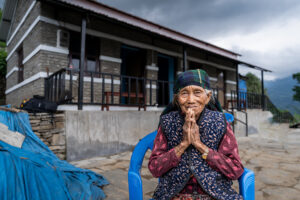
For Lila Kumari, it is not just a home; it is a gift of safety and peace. “I like the new house very much. Even if I die, my grandchildren will be able to live in this safe house,” she says.
The GWT also provides Lila Kumari with a monthly pension, which is directly deposited into her nearby bank. “Although it is not enough for all of us, it means a lot to me,” she says. “The GWT team visits me regularly, brings me medicine for my blood pressure and stomach problems, and checks how I am doing. I never feel alone.”
“I want to thank the supporter for the help,” she says with a smile. “Dhanyabaad!”