Into the Flood-Affected Trishuli Valley – A First Hand Field Report

When disaster changes everything
For people living in Nepal, the monsoon is a season of uncertainty. Heavy rainfall can bring floods and landslides with little warning, disrupting daily life, cutting off roads and communities, and, in the worst cases, taking lives. But this year there was an even more devastating event. In the mountainous north of the country, a glacial flood caused a surge of water and debris that swept through the valley, causing widespread destruction. The floodwaters rushed down towards the Trishuli River, affecting communities across Rasuwa, Nuwakot and Dhading.

Riverside settlements were badly affected. Houses were swept away, roads and bridges were destroyed, and communities were left struggling to reconnect with the outside world. Along the Trishuli River, the force of the water left behind thick layers of mud and sand, while the marks on the riverbanks showed just how high the water had risen.
For The Gurkha Welfare Trust, the situation meant that some of our pensioners and their families were suddenly facing an uncertain and difficult time.
A journey into an uncertain situation
Last week a team was deployed from our Area Welfare Centre in Bagmati to the flood-affected areas of Nuwakot and Dhading, where our pensioners were waiting for their regular pension payments, medical check-ups and medicines.

The team also needed to visit Gurkha widow Ninma Tamang Ghale and her family, whose home had been completely swept away by the flood. According to information held by our Area Welfare Centre in Bagmati, the homes of three of our pensioners in the area have been lost or damaged. Thankfully, the pensioners and their families stayed safe. But for those families, the loss of their homes meant that life changed almost overnight.
Through the wreckage
Our team set off early in the morning, unsure of what they would find ahead. The usual journey to Trishuli would take around three to four hours. This time, however, the journey was very different. The team had to take another route. Several bridges had been destroyed, and the main route into the area was no longer accessible. Fortunately, the team’s driver, Man Sing Tamang, was from the area. His knowledge of the local roads and contacts along the way proved invaluable as the team took an alternative route from Galchhi.

The road quickly became rough and difficult. It was muddy, uneven and slippery in places, with the effects of the flooding visible around them. “As we travelled closer to the Trishuli River, the landscape began to tell its own story.” Kushal Thapa
“The river was now wide, dark and fast-moving. Along its banks were thick deposits of mud and sand. High above the water, the remains of a suspension bridge stood as a stark reminder of the flood’s force. Although its metal cables were still intact, the bridge itself had been badly damaged. “It was difficult to imagine the power of the water that had swept through the valley.”

Challenges on the Road
Then, on the road ahead, the team faced another setback. One of the vehicle’s tyres was punctured. “It was the last thing we needed in an already challenging journey. Fortunately, we had the necessary tools with us and were able to replace the tyre before continuing.”

“Our destination for the night was Samari, a basic settlement where accommodation was limited. We had to share rooms, but after the journey we were grateful simply to have somewhere to stay. There was electricity, although it was unreliable. Local people told us that the area had been without electricity for a week following the disaster.” Kushal Thapa
Seeing the scale of the destruction
The journey had taken longer than expected, but along the way the team also visited several pensioners whose homes had not been directly affected by the flood.
They were safe and doing well, but the disaster had still disrupted their lives. The main bazaar had been badly affected, electricity had been unavailable for periods of time, and the road connecting the area with Kathmandu had become extremely difficult to travel. With roads damaged and access restricted, even getting essential supplies into the area had become a challenge.

For these pensioners, the most important thing was that they and their families were safe. But as the team travelled further into the affected area, it became clear just how fortunate some families had been.
A town buried in mud
When the team went to visit Ninma Tamang, Welfare Officer Bishnu Garbuja Pun took them to see the affected area and the place where Ninma’s home had once stood. He described the scene.
“People were moving around the area. Some were waiting in queues or gathering in groups to receive relief supplies. Others were carrying sacks of rice home. There was movement and activity, but it was only when we climbed to a higher point and looked down towards the river that the true scale of the disaster became clear.”
“The Trishuli River had become enormous. From above, it looked like one vast, dark and murky stretch of water. It was difficult to imagine that a home had once stood beside it. But there was no sign of Ninma’s house. It had simply gone. Where her home once stood, there was almost nothing left to see. Among the destruction, the only visible reminder of a house was part of a brick wall. Everything else had been swept away.”
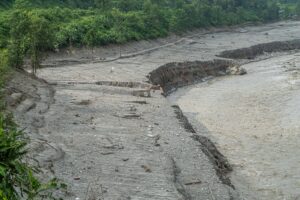
“We then continued towards the Trishuli corridor bazaar. The scene was difficult to take in. The usually busy area had fallen almost silent. People were moving carefully through the destruction, trying to recover whatever they could from homes and shops buried beneath mud and sand. Everything closest to the river had been swept away.”
“Further inland, some houses were still standing, but in many cases one or two floors had been buried beneath thick layers of mud and sand that had already hardened. Some had lost walls, doors or windows. Others had been moved from their original foundations by the force of the water. Some homes had disappeared completely beneath the mud.”

“In places, we were literally walking across the roofs of houses as though they were the ground. People’s belongings were scattered everywhere: cooking utensils, clothes, children’s toys and the possessions of shopkeepers. Much of what families owned had either been washed away or buried beneath the mud.”
“Roads that had once connected one part of the town to another had simply ended where the flood had torn them away. Excavators were working to clear routes through the debris, while people searched through the mud, trying to recover whatever remained of their homes and belongings.”
“It was impossible not to think about what people had experienced that day.“

“The loss of homes and possessions was visible everywhere, but behind the destruction were also the things we could not see: the fear of what had happened, the trauma of losing everything familiar, and the grief of those who had lost loved ones.”
“Many people lost their lives. We met few people in other areas as well. When we talked with them, they had lost someone close or distant in the flood. For older people, young children and newborn babies, and for the families caring for them, the experience must have been unimaginably frightening.”
And somewhere within all this destruction were Ninma Tamang and her family, who had seen all this up close and experienced this such a disaster firsthand.