Lest We Forget: Remembrance Day 2023

Today we remember the brave soldiers who gave their lives to protect our freedom. Each year, at the eleventh hour of the eleventh day of the eleventh month, we observe a silence to remember those who have suffered or lost their lives during war or conflict.
As we remember the fallen, let us not forget the Gurkhas.
Through the decades, roughly 19,000 Gurkha soldiers have died in the many wars they’ve fought at Britain’s side. It is often said that, if there were a minute’s silence for every Gurkha casualty, we would need to be silent for a whole month.
Sir Ralph Turner MC, a Gurkha officer during this time, gave the soldiers their reputation from his quote:
“Bravest of the brave, most generous of the generous, never had a country more faithful friends thank you”.
Our debt of honour
Many thousands of Gurkhas were wounded in their service and returned to a life of hardship in Nepal, living in poverty-stricken communities in a country at constant risk of earthquakes and monsoon flooding. They depend on the financial and medical aid they receive from The Gurkha Welfare Trust for their survival.
As we commemorate another Remembrance, now is the time to stand by these gallant veterans, many in their eighties and nineties, who want nothing more than to live in their homeland with security and dignity.
A veterans story
For over 50 years we have been supporting Gurkha veterans, their widows and communities in Nepal. Riflemen Balbahadur Khadka, veteran of the Assam Rifles, is one of the thousands of Gurkhas who rely on the financial and medical aid we provide for their survival.
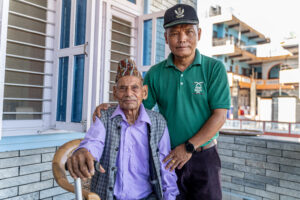
Balbahadur celebrated his 100th birthday earlier this year, and for a centenarian, he is remarkably active and can still get around the house with the help of a walking aid provided by GWT. He lives with one of his sons in Gagangaunda Bazar, east of our Area Welfare Centre in Kaski.
Our Pensioner Support Team visits Balbahadur regularly to check on his health and deliver his pension, and he always enjoys the opportunity to reminisce.
“My name is Balbahadur. I was born a hundred years ago (101 in nepali birth years!) My original home is in the hills. I now live in turn with my five sons.”
Enlisting in the Army
“I must have enlisted when I was only seventeen or eighteen. Back then, Gallah Walas (recruiters) used to come to the villages and take young boys to the plains to get enlisted. “Back then, being a ‘lahure’ (British India Army) meant steady income and security of food and clothing. We went to Gorakhpur (India) and got enlisted. There were no roads back then so we had to walk all the way. There were three of us from our village who enlisted… I am the only one alive now.”
Patrolling the jungles of Burma
“We went to many places after being posted into the Assam Rifles. We scoured the whole of Burma to fight against the Japanese enemy. We used to be patrolling the jungles for eight to nine days at a time, surviving on roots and jungle plants only. That’s when I realised that not only cattle but humans could also survive on plants. The water source was occupied by the enemies so we could not drink. And when we finally arrived at the camp and ate a proper meal, we could not digest it properly.”
In the firing line
“During one of the patrols, one of my colleagues got shot in the leg by the enemy. We also fired back but don’t know if the enemy side suffered any casualties. I was tasked to carry him. I knew it would slow me down and we both could be easy targets for the enemy. There was no turning back, I could not run away, I had gone to fight the enemy. Somehow, we managed to carry the injured, turn by turn, over a hill to the camp where he was safe and treated.”
“We could not afford to get scared, we were deployed to fight. If we ran away, we would be dead!”
Balbahadur was discharged from the army when he fell ill with TB and was sent back home in January 1945.
Returning to his homeland
“After returning to Nepal, it was doing what every villager does; looking after the cattle and working in the fields, growing rice and millet. Life was difficult. I did not get a pension and later came to know from the villagers that the GWT provides a welfare pension to ex-servicemen like me. It was a happy moment when I got the pension.”
The pension is a lifeline for so many veterans like Balbahadur who fought so bravely in harsh conditions, and now deserves to live his life with dignity.