The Service and Sacrifice of Rfn Bhakta Bahadur Pun
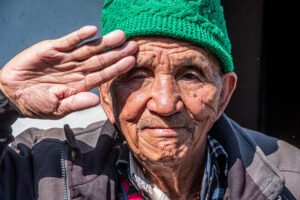
This Remembrance Day, as we honour the courage and sacrifice of service personnel across the globe, we share the story of Rifleman Bhakta Bahadur Pun. From the rugged trails of Nepal to the deep jungles of Brunei and Hong Kong, his journey reflects the enduring resilience, quiet dignity, and sharp skills of the Gurkha soldier.
A Journey Built on Endurance
Bhakta Bahadur Pun sits quietly in his home in Kaski, Nepal, reflecting on a life shaped by military service. Official military records list his age as 78, but he offers a gentle smile and a quick correction: “My actual age is 82. But back in the Army days, records were not always exact.”
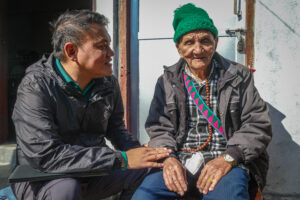
His path to service began with sheer determination. At 18, he embarked on a gruelling 265-kilometre journey on foot from his home in Myagdi to the recruitment centre in Paklihawa. Upon selection, the swift rhythm of military life took over, a constant cycle of physical conditioning, marching, and tactical drills. His initial training brought him to Singapatani, Malaysia, for seven months, followed by deployments to Brunei.
The training was relentlessly demanding. In Brunei, recruits had to train in heavy boots, socks, and shorts, but without shirts.
“It used to be cold,” he recalls. “For me, it felt like punishment. But I endured, as I did with many challenges in service.”
Courage, Survival, and Sharp Eyes
Life on duty brought constant hazards and narrow escapes.
One incident in Hong Kong still stands out vividly. After returning from training, Bhakta Bahadur and five others were placed in a vehicle carrying ammunition. A punctured tyre caused the vehicle to turn over. “I nearly died,” he says quietly. The vehicle slipped off the cliff edge but was caught by a rubber tree, preventing a worse fall. Ammunition boxes fell on him, trapping his legs. Other soldiers rushed in and pulled him free. He survived without major injuries, but the pain in his legs, he says, still returns at times.
Another close call occurred during roll call in Brunei. While polishing his boots under a tree, a whistle blew suddenly. As he sprang to his feet, his head struck a low-hanging branch, knocking him unconscious. He awoke in the hospital with a fractured skull that required immediate stitches, yet he returned to duty as soon as he recovered.
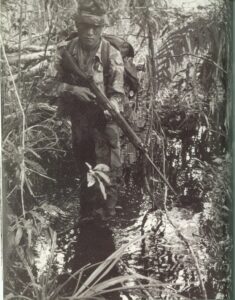
Despite the hardships, there were moments of pride. Bhakta Bahadur was known as a sharpshooter. Training began at 25 yards, then 100, and eventually at further distances. “I was good at it,” he says with a grin. “I used to win bets. The officers used to say, ‘This boy’s eyes are sharp.’”
During a high-stakes river-crossing exercise, soldiers were tasked with traversing a river via rope without touching the water. Unaware of his timing, Bhakta Bahadur finished first. That evening, when the Commanding Officer called him forward, he expected a reprimand. Instead, the officer publicly commended his performance and rewarded him with two cases of beer to share with his comrades.
Into the Jungle
“Training was constant, sometimes enjoyable, often exhausting. Much of it took place deep in the jungles of Brunei. We would patrol at night, carrying heavy backpacks filled with rations and ammunition. Those carrying an LMG had around 300 rounds; riflemen carried three magazines with extra rounds in their packs. We were not allowed to use any lights. Instead, we tied a piece of a rotten branch to our backs; the faint glow helped us follow the soldier in front. Each patrol could last up to fifteen days. There was always fear of snakes, wild animals, and the unknown. We even heard stories of a soldier being wrapped by a large snake, only to be rescued by another comrade.”
Life After Service and a Legacy of Gratitude
After serving six years and seven days, Rifleman Bhakta Bahadur Pun was honourably discharged from Casino Camp in Hong Kong. Though he wished to complete a full career, unit seat limits at the time meant a return to civilian life in Nepal. “I had no intention of returning so soon. I wanted to complete my full service. If I had not returned, I might have reached Lance Corporal.”
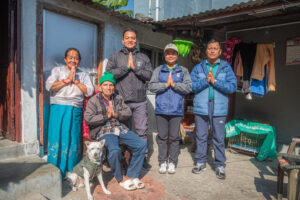
Back home, he worked in the Nepal Police, farmed, and took on heavy labour, cutting trees and breaking stones to support his family. In 1989, he began receiving a welfare pension, supported by the Gurkha Welfare Trust. Over the decades, this support grew, alongside vital medical care for both him and his wife, Pan Suba Pun.
Today, Bhakta Bahadur lives quietly in Kaski with Pan Suba. While time has slowed his steps, his pride in his service remains intact.
“Thank you to all the donors and supporters for their help. We are happy. Keep supporting us.”