Breaking Barriers to Healthcare: Life-Changing Support in Remote Dailekh
The Challenges of Life in Western Nepal
The town of Dailekh, lies within a rural district in western Nepal’s Karnali Province. Its rugged hills and valleys are home to thousands of families who depend largely on agriculture and livestock for their livelihoods. Settlements are scattered across steep terrain, and many residents must walk long distances to reach essential services such as schools, markets and healthcare facilities.
Reaching Dailekh Bazaar from GWT HQ in Pokhara takes around two days by road. While infrastructure such as roads, electricity and mobile networks has improved in recent years, access remains difficult, especially during the monsoon season, when landslides frequently block roads and disrupt travel.
Overcoming the Healthcare Gap
Access to healthcare remains one of the biggest challenges in the region and most residents depend on local health posts and the district hospital, where specialist services are scarce.
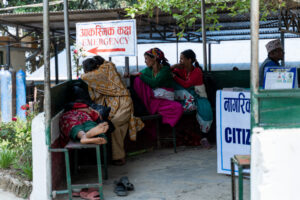
Approximately 3.2% of the population lives with a disability, while 35.8% lives below the poverty line, making it particularly difficult for families to afford treatment outside the district. Although the literacy rate stands at 75.5%, awareness of disability-related conditions and available support services remains limited. Shortages of trained personnel, specialist equipment and rehabilitation services mean that many individuals live for years with untreated hearing loss, mobility impairment and other conditions.
A Lifeline for Isolated Communities
As a result, many people with hearing loss, visual conditions, disabilities and long-term health issues do not receive the care they need. Conditions that could be treated or managed often worsen because services are either too far away or too expensive to access.
For residents of Dailekh, outreach medical camps are therefore more than routine services—they are often the only opportunity to consult specialists, receive treatment, or access life-changing support.
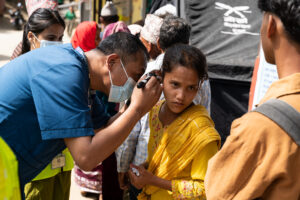
Our recent camp in the area helped 559 with various health conditions, including ear surgery, hearing aid distribution and assistive device measurement and distribution. Here are the stories of just a few of the people our team met and helped at the camp.
Madan’s Story
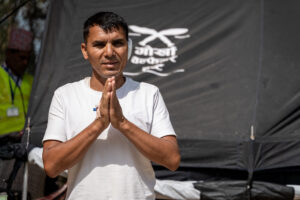
Madan Prakash Thapa travelled for 40 minutes by bus to reach Dailekh Bazaar.
Prior to attending the Medical Camp he lived with hearing problems for many years. He said: “I have had hearing problems since I was young.” He explained that cleaning ears with chicken feathers is common in remote areas, but it caused serious damage for him. He said: “The use of chicken feathers for cleaning the ear damaged the eardrum in my left ear, and the swelling continued.”
At the outreach camp, Madan received specialist care. “I came here, and the doctors have operated.” He understands that the treatment may not fully restore his hearing: “I am aware it is not going to restore my hearing, but I hope the swelling and infection will stop now, or the condition will not become worse.”
For Madan, the medical camp has made a real difference to people living in remote communities. He said: “This medical camp has really benefitted the remote people of Dailekh. To get this kind of specialist treatment would have been expensive. To have the service here and free of cost is highly commendable.”
He also thanked those who supported the camp, saying: “The thought of the supporters helping people in the remote areas of Nepal is really generous. I want to express my heartfelt thanks.”
Dilip’s Story
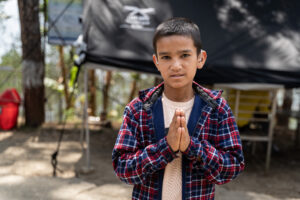
Dilip Sarki travelled for three hours by bus to reach the outreach camp with his mother, Dhani.
Life has been difficult for the family. Dhani said: “Because of the lack of employment opportunities in the village, I had to send my elder son to India to earn a living.” She added: “I was forced to stop his education and send him to India for work. He is 19 now, and he went there when he was 12.”
Dhani said the money her elder son sends is irregular, but it still helps the family. She shared: “He only sends money occasionally, but it helps us buy everyday essentials such as cooking oil and salt.”
When asked whether her husband works, Dhani replied: “No, he does not. He often begs for money, buys alcohol when he can, and sleeps wherever he ends up.”
Dhani also has health problems of her own. She said: “Both my legs have shrunk, which makes it difficult for me to walk properly. My back is also weak.” She had been resting for almost two weeks, but she still came to the camp for Dilip. She said: “I had to come here today for his sake.”
Dilip is now 12 and will soon turn 13. Dhani said: “He used to be able to hear until he was two years old. After that, I realised he was not hearing properly and often kept to himself.” She added: “He is studying in a government school in class five. His writing is good, but he cannot speak well.”
During a short conversation at the camp, Dilip was asked his name. He answered: “Dilip.” When asked which class he was in, he replied: “Five.” When asked his brother’s name, he said: “Mukesh.”
After receiving the hearing aid, Dilip was asked if he was able to hear. He nodded his head to confirm that he could hear. When asked if he was happy, he again nodded his head to say yes.
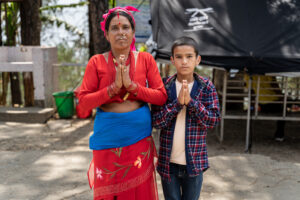
Dhani believes the hearing aid will help her son. She said: “I believe the hearing aid will benefit him. I did ask him, and he says he can hear properly now.”
For Dhani, the support means a great deal. She said: “For people in our situation, who can hardly afford medicine, this assistance is a tremendous help.” She added: “Many thanks to you all. I am happy.”
Ramesh’s Story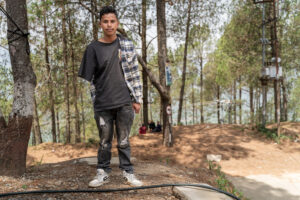
Ramesh BK is married and has a five-month-old son. He started working when he was 15 years old. He said: “I used to work as a labourer to support my family, filling gabion boxes in the river.” One year ago, Ramesh’s life changed after an accident. He said: “I got electrocuted when the electricity pole leaked current into the river.” He went to India for treatment, where his hand had to be amputated. He added: “I have never worn an artificial hand.”
Travelling for support is difficult and expensive for Ramesh. He explained: “It takes four hours by jeep from my village to Dailekh Bazaar, and it costs Rs 1,000.” For someone without regular income, this is a huge obstacle.
Ramesh is now unemployed. He said: “I want to become an electrician, but basically I want to work anyhow to make a living, with whatever job I can get.”
At the outreach camp, measurements were taken for a prosthetic hand which will be fitted after a few weeks. He said: “I know the artificial hand is just for show, but it is costly and it is free here.” For Ramesh, this gives him some hope as he tries to rebuild his life and find work again.
In a region where geography and poverty create massive barriers to basic healthcare, these camps are a vital lifeline. We are only able to bring these life-changing specialist services, free surgeries, and assistive devices to remote corners of Nepal because of the incredible generosity of our supporters. Your kindness ensures that even in the most isolated communities, no one is left to face debilitating health conditions alone.